

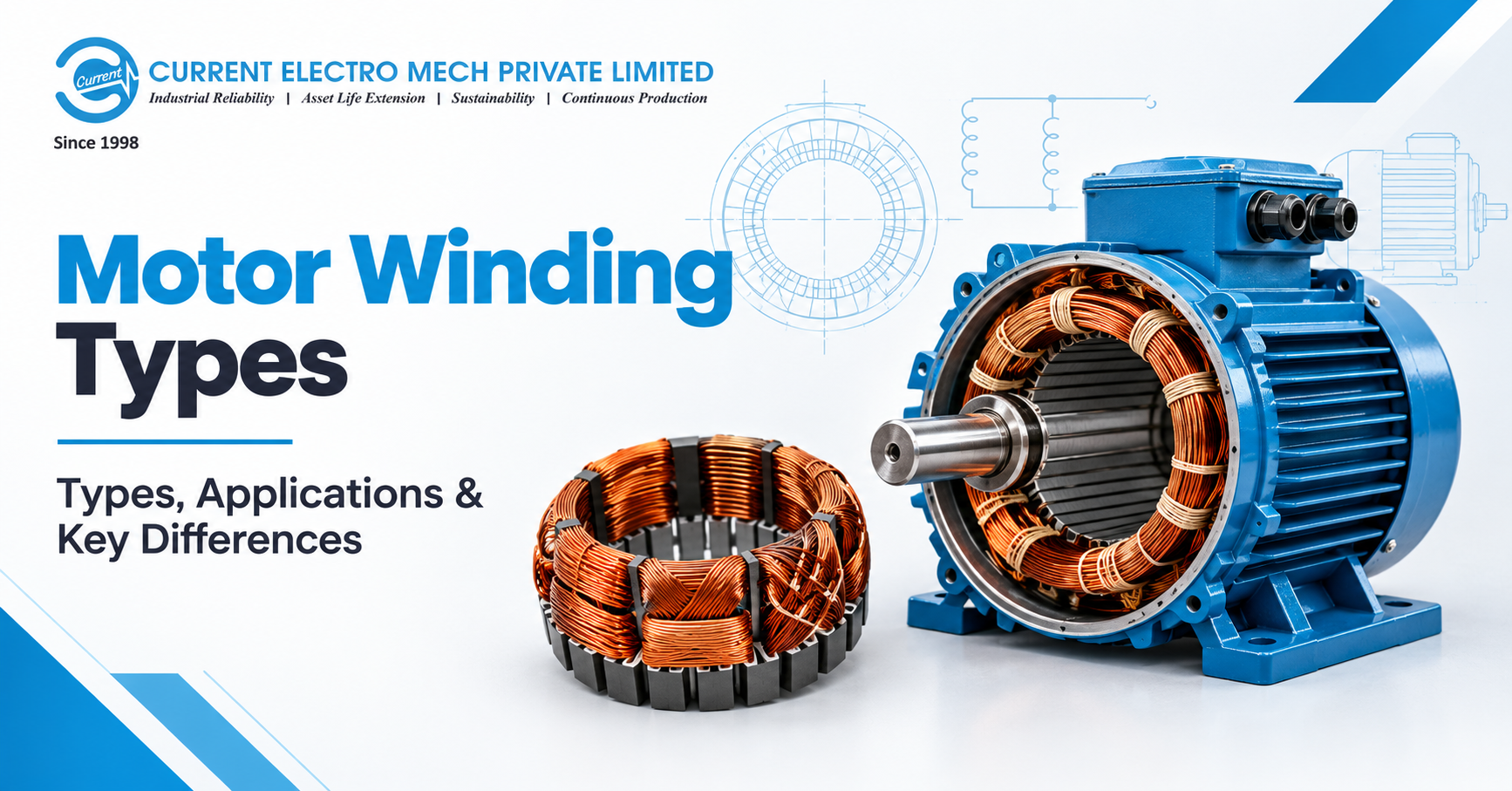
Motor Winding Types - Different Types, Functions and Applications
Motor winding types describe the ways electrical conductors are arranged inside an electric motor. The winding design influences how the magnetic field is created, how the motor runs and how efficiently it delivers torque.
The main motor winding types include stator winding, rotor winding, concentrated winding, distributed winding, lap winding, wave winding, single-layer winding and double-layer winding. Each type explains an aspect of motor construction so knowing their differences is important when choosing or designing a motor.
Different Types of Motor Windings
Stator Winding
Stator winding is placed in the part of an electric motor. When electrical current flows through the winding it creates a field that interacts with the rotor to generate motion.
Common applications: induction motors, pumps, compressors, fans and synchronous motors.
Rotor Winding
Rotor winding is associated with the rotating part of a motor. In the wound‑rotor induction motors insulated conductors carry current. In synchronous motors rotor windings produce the magnetic field through DC excitation.
Not every motor has a rotor winding. Squirrel‑cage induction motors use bars while many brushless motors use permanent magnets.
Common applications: Slip‑ring induction motors and wound‑field motors.
Winding
Concentrated winding groups coil around individual stator teeth or a limited number of teeth instead of spreading them across many slots. This arrangement can reduce end‑winding length, save copper and simplify manufacturing. However some designs produce magnetic harmonics and greater torque ripple.
Common applications: Selected brushless DC motors, stepper motors and compact servo motors.
Distributed Winding
Distributed winding spreads coils across stator slots. This arrangement can produce a magnetic field and reduce certain harmonics, vibration and electromagnetic noise. Although it may require longer end connections, distributed winding is widely used in motors that need consistent performance.
Common applications: Three‑phase induction motors, synchronous motors and generators.
Concentrated vs. Winding: Concentrated winding groups coils around teeth while distributed winding spreads them across several slots. The choice depends on torque requirements, efficiency, motor dimensions and manufacturing considerations.
Winding
Lap winding is an armature winding configuration used in DC machines. The coil connections form parallel paths making this arrangement suitable for applications requiring relatively high current at lower voltage.
Common applications: Selected DC motors and DC generators designed for high‑current operation.
Wave Winding
Wave winding is another DC armature winding configuration. Its connections progress around the armature in a wave‑like pattern. A conventional simplex wave winding has two paths regardless of the number of poles.
This arrangement is generally suitable for higher‑voltage, lower‑current applications compared with a comparable lap winding.
Lap vs. Wave winding - The Differences
Lap winding generally provides parallel paths and higher current capacity while simplex wave winding provides fewer parallel paths and is suited to relatively higher voltage.
Single‑Layer Winding
In single‑layer winding each stator slot contains one coil side. This arrangement can simplify construction. Reduce the need for insulation between winding layers within a slot. Its suitability depends on the slot arrangement, pole count and required electromagnetic performance.
Common applications: Selected induction motors and other electrical machines designed for single‑layer construction.
Double‑Layer Winding
In double‑layer winding each stator slot contains two coil sides, arranged in upper and lower layers. This provides flexibility in coil pitch and winding layout. Double‑layer winding is commonly used in motor designs because it supports a wide range of electromagnetic configurations.
Common applications: Three‑phase induction motors, synchronous motors and other industrial electrical machines.
Single‑layer vs. Double‑layer winding: Single‑layer winding places one coil side in each slot while double‑layer winding places two. Double‑layer designs offer winding flexibility but require suitable insulation between layers.
Hairpin Winding
Hairpin winding uses -shaped rectangular copper conductors that are inserted into stator slots. Their ends are usually joined by welding. Hairpin winding is especially useful for electric traction motors. I have seen this used in projects.
This construction can give slot-fill rates and enable automated manufacturing. However it needs joining processes and careful control of electrical losses. I find that careful control is essential.
Common applications include electric vehicle traction motors and some high-power-density electric drives. I think these are the common uses.
How to Choose the Right Motor Winding Type
The appropriate motor winding depends on the motors intended use and operating requirements. I believe that choosing the winding is crucial.
Industrial induction motors: Distributed stator windings are widely used for continuous operation. I have seen them in industrial settings.
Compact motors: Concentrated windings can be suitable when construction and manufacturing simplicity are priorities. I think this is a choice for small devices.
DC machines: Lap or wave winding is chosen based on the required voltage, armature design. I have used both types in projects.
Modern electric vehicle motors: Hairpin winding can support slot fill and automated production. I believe this makes production faster.
Motors requiring coil arrangements: Single-layer or double-layer winding is selected according to the slot configuration and electromagnetic design. I find that single-layer is easier to manufacture.
Other factors such as rated voltage, speed, torque, cooling, insulation and efficiency must also be considered. I always check these parameters.
Conclusion
Different motor winding types serve electrical and mechanical requirements. Stator and rotor windings describe winding location. Concentrated and distributed windings describe coil arrangement. Lap and wave windings describe DC armature connections. Layer, double-layer and hairpin winding describe other aspects of winding construction. I think understanding these categories is helpful.
Understanding these differences helps engineers and industrial users make decisions when evaluating motor designs and their applications.
Frequently Asked Questions
What are the main types of motor winding?
The main types include stator winding, rotor winding, concentrated winding, distributed winding, lap winding, wave winding, single-layer winding and double-layer winding. Hairpin winding is another construction method used in modern electric motors. I have reviewed all these types in my work.
Which winding is commonly used in motors?
Distributed stator windings are widely used in industrial induction motors and synchronous machines. The exact configuration depends on the motors design and operating requirements. I have seen distributed stator windings in machines.
What is the difference between lap winding and wave winding?
Lap winding generally has parallel current paths making it suitable for higher-current DC machines. Simplex wave winding has two paths and is generally suited to higher-voltage lower-current DC machines. I prefer lap winding for current machines.
Does motor winding type affect efficiency?
Yes. Winding arrangement influences resistance, magnetic harmonics, copper losses and thermal performance. However overall motor efficiency also depends on the core, cooling, operating load and other design factors. I note that efficiency depends on factors.

Comments are closed