

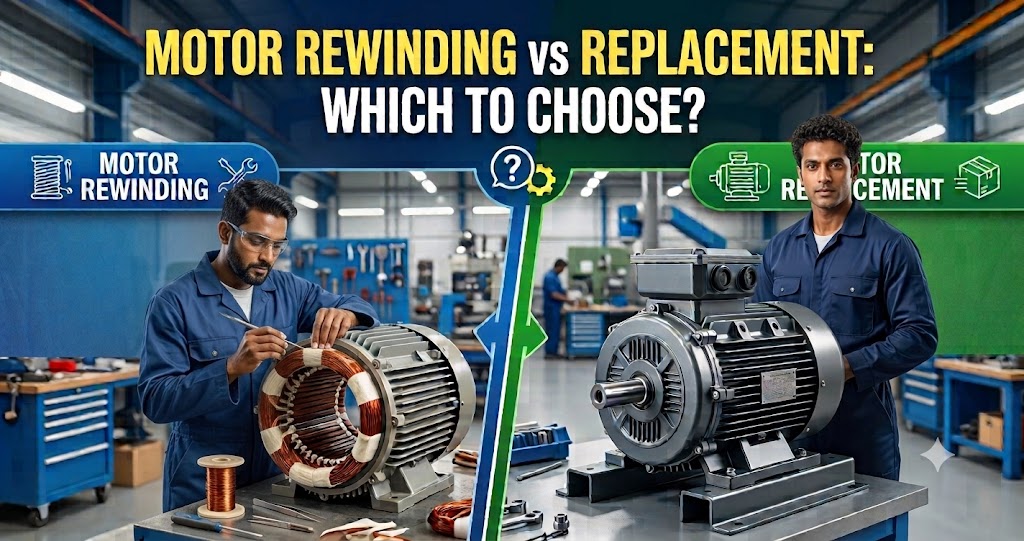
When a critical HT motor fails on your Industrial Unit, the clock starts ticking immediately. Every hour of downtime means lost production, and the pressure to make a fast decision is real. But the choice between rewinding and replacing your motor isn’t just about speed, it’s a decision that affects your maintenance budget, energy costs, and equipment reliability for years to come.
At Current Electro Mech, we’ve serviced over 3 lakh motors across 26+ years, and this is one of the most common questions plant managers and maintenance engineers ask us. Here’s a practical framework to help you decide.
What Is Motor Rewinding?
Motor rewinding is the process of removing a motor’s damaged or worn-out stator windings and replacing them with new copper windings, matched to the original (or improved) specifications. A proper rewind typically also includes:
- Core inspection and core-loss testing
- Rotor inspection and shaft assessment
- Insulation system upgrades
- Vacuum Pressure Impregnation (VPI) for sealing and moisture protection
- Dynamic balancing before the motor goes back into service
Done correctly by an experienced shop, a rewind can restore a motor to its original performance — and in many cases, even improve efficiency through better winding design and higher-grade insulation materials.
What Is Motor Replacement?
Replacement means retiring the failed motor entirely and installing a brand-new unit. This is usually the more straightforward path for smaller, standard-frame motors where new units are cheap, easy to source, and readily available off the shelf.
Key Factors That Should Drive Your Decision
1. Motor Size and Horsepower
Small motors (roughly 50 HP and below) are often more economical to replace outright, since standard replacements are inexpensive and easy to source. Larger and HT (High Tension) motors, on the other hand, are usually strong rewind candidates; replacements are expensive, custom-built, and can take months to arrive.
2. Age and Repair History
A motor that has already been rewound two or three times deserves closer scrutiny. At that point, it’s worth checking the condition of the core and mechanical components before deciding whether another rewind still makes sense, or if it’s time to retire the unit.
3. Core Condition
Core-loss testing is one of the most important and most overlooked steps in this decision. If the stator core shows excessive losses, the motor’s magnetic circuit may be compromised. In such cases, core restacking (replacing the laminations) or full replacement becomes necessary.
4. Efficiency Requirements
Modern rewinding practices using precision winding techniques and better insulation classes can maintain or even improve a motor’s original efficiency. That said, if your facility has moved to a higher efficiency standard (like IE3 or IE4), a premium-efficiency replacement might be the better long-term investment, especially for motors that run continuously.
5. Urgency and Lead Time
New custom or large motors can have lead times stretching from several weeks to over a year, depending on size and specification. A quality rewind, by contrast, can often be turned around in days, a major advantage when your production line can’t afford extended downtime.
6. Cost Comparison
As a rule of thumb, if a rewind quote comes in above roughly 50–60% of the cost of a new motor, it’s worth seriously evaluating replacement instead. For most mid-to-large industrial motors, however, a quality rewind typically costs significantly less than a new unit while restoring the same performance.
7. Sustainability
Rewinding also has an environmental upside: it keeps the vast majority of the motor’s copper, steel, and other materials in service, reducing both waste and the carbon footprint associated with manufacturing a new unit from scratch.
A Simple Decision Checklist
Ask yourself these questions before deciding:
- Is this a small, standard motor readily available off the shelf? → Lean toward replacement
- Is this a large, HT, or custom-built motor? → Lean toward rewinding
- Has the core passed loss testing? → Rewind is viable
- Has this motor already been rewound 2–3 times? → Get the core evaluated first
- Is downtime costing you heavily right now? → Rewinding usually wins on turnaround time
- Are you upgrading to meet new efficiency mandates? → Consider replacement
How We Current Electro Mech Can Help
With 26+ years of experience and over 3 lakh motors serviced, our team handles the full spectrum of motor servicing from HT motors, AC and DC motors, servo motors, and alternators, to core restacking, VPI, and dynamic balancing. We test before we recommend, so you get a clear, honest answer on whether rewinding or replacement makes sense for your specific motor, not a one-size-fits-all sales pitch.
Facing a motor failure or planning preventive maintenance? Get in touch with our team for an assessment, or call us directly at 7598788401.
Current Electro Mech Private Limited, Erode, Tamil Nadu Service & Coil Rewinding of Electrical Machines since 1998.

Comments are closed